Democratic Senate primary poll analysis
Monday, Dec 14, 2009 - Posted by Rich Miller
* Let’s have a look at the Tribune’s Senate Democratic primary polls, shall we? The toplines and crosstabs are here. The news story is here.
Democratic matchup…
Giannoulias 31
Jackson 17
Hoffman 9
Boyd 2
Meister 1
Marshall 1
Dabney 1
Other cand. (Vol.) 3
Undecided 35
Progress Illinois compares those numbers with previous candidate polling…
Meister Poll (December 3)
Giannoulias: 33%
Jackson: 10%
Hoffman: 7%
Meister: 1%
Uncommitted 49%
Jackson poll (November 10)
Giannoulias: 31%
Jackson: 13%
Hoffman: 8%
Meister 2%
Undecided: 45%
Hoffman poll (October 13)
Giannoulias: 26%
Jackson: 12%
Hoffman: 7%
Meister N/A
Undecided: 55%
Jackson is doing significantly better in the Tribune poll than in any of the other surveys. Hoffman is about the same. After getting a bump in November, Giannoulias is about the same.
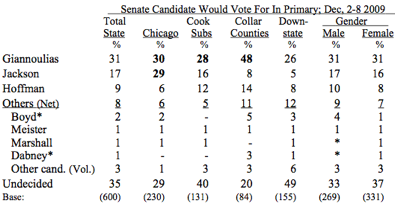
Tribune crosstabs…
Also…
Among white primary voters, Giannoulias leads Jackson 38% to 6%. Among African-American voters, Jackson leads 45% to 13%
And…
Giannoulias’ strongest geographic support came from collar-county primary voters, 48 percent of whom backed his bid compared with 14 percent for Hoffman and 8 percent for Jackson. Among Chicago voters, Giannoulias and Jackson were virtually tied at around 30 percent support, while the treasurer held a 28 percent to 16 percent edge over Jackson in the Cook County suburbs, where 40 percent of voters said they were undecided.
If Jackson has the money to compete, she’ll likely come close to sweeping the African-American vote and may do significantly better with women. Whether that’s enough to be victorious will depend on whether Hoffman can somehow jump-start his campaign and Meister can gain a little traction. Meister is focusing on the gay and gay friendly vote as his base, and that’s not inconsequential. Still, Boyd was removed from the ballot, but still outpaced Meister, who has put serious money into his campaign.
Name rec…
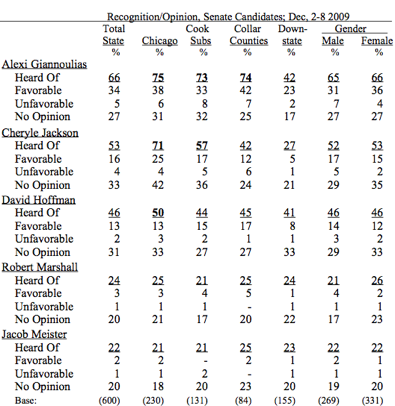
You can probably downplay the generic name rec numbers in these contests. It’s probably better to focus on the percentage of people who know enough about the candidates to rate them. A good example of this is Robert Marshall, a radiologist who practices in Kankakee and Joliet. He’s never run for office as a Democrat and has received almost zero coverage, yet 24 percent claimed to have heard of him. Only four percent knew enough about him to rate him, however, and that’s probably too high.
If you look at the name rec numbers that way, you get this…
Giannoulias 39
Jackson 20
Hoffman 15
Marshall 4
Meister 3
Back to the story…
The survey found plenty of room for movement before the Feb. 2 primary elections, with 35 percent of Democratic voters saying they were undecided. The major contenders only recently have begun to roll out their campaigns on the TV airwaves.
Methodology…
This Chicago Tribune Poll is based on interviews of confirmed registered voters likely to vote in the February 2nd Democratic and Republican primaries. In 2008, Illinois primary elections were moved to the first Tuesday in February - for both presidential and off-year state office contests. Before then, primaries were held on the third Tuesday in March. Interviewing was conducted December 2nd to the 8th.
State samples of 600 were interviewed for each state primary. Potential margin of error for each sample is +/- 4.0% at the 95% confidence level. Likely voting was determined based on scale question response.
That last sentence apparently means they didn’t use a voter file to determine likely voters in any of these polls. So, this survey probably captures a lot of low-information voters.
Thoughts?













- 47th Ward - Monday, Dec 14, 09 @ 11:04 am:
===they didn’t use a voter file to determine likely voters in any of these polls===
Good point Rich. Those polled are self-described “likely voters” and in the absence of voting history, we’ll have to take their word for it. That, to my mind, makes this slightly less reliable than polling only those with a proven history of voting in primaries over several election cycles.
No one really wants to admit to a pollster that they aren’t going to vote. So while the results are otherwise pretty dependable, it may make it hard to compare this survey with others that seek out only those with a proven track record of voting.
I think there is still plenty of volatility in the Senate and Governor’s primary races, but so far so good for Giannoulias and Quinn.
- WideOpen - Monday, Dec 14, 09 @ 11:05 am:
Great pull-together of all available data, Rich.
The fundamental thrust of all this data is that this race is wide, wide open. Alexi must be pretty scared. Given his statewide office, his money, and his endorsements, he’s not closing the deal.
The debates are going to be huge here.
- ivoted4judy - Monday, Dec 14, 09 @ 11:05 am:
I think Jackson’s problems will be the turnout on February 2nd. Sweeping the black vote may not be that much help if the turnout is in the low 20pct. I see nothing happening between now and February that will energize the black vote in Cook County. This race is Alexi’s to win.
- VanillaMan - Monday, Dec 14, 09 @ 11:08 am:
Geez.
With Hoffman rising and Jackson finding her core, Giannoulais can’t sit still. This just doesn’t look good for anyone but Mark Kirk.
I still foresee a worrisome split here, giving Jackson the nomination with a plurality. And that would be it for the old Burris senate seat.
- shore - Monday, Dec 14, 09 @ 11:08 am:
hoffman might be better off in the republican primary. heir to a business fortune, worked for rehnquist, crime fighter, prosecutor. Those are things that republicans running for office generally do. He seems conflicted on a lot of issues like trade where according to the trib board thing he’s a free trader. Even the guy he worked for, Boren is a very conservative democrat.
- VanillaMan - Monday, Dec 14, 09 @ 11:09 am:
Let’s not forget the old Miller rule regarding AA voters - they don’t seem to settle until near Election Day. Jackson’s numbers are going up.
- Rich Miller - Monday, Dec 14, 09 @ 11:16 am:
VM, you forgot one part of my rule. Perhaps the most important part.
African-American voters usually tend to vote in high numbers for a viable black candidate. That’s TBD with Jackson to date.
- ShoreShill - Monday, Dec 14, 09 @ 11:16 am:
Hey, Shore– thanks for the Alexi FUD. David Hoffman is a lifelong Democrat with a distinguished resume working in all three branches of federal government.
- Bakersfield - Monday, Dec 14, 09 @ 11:17 am:
I was going to ask if anyone else thought that this poll was not the best news for Alexi- buuuuut everyone else seems to agree.
African American turnout could be higher than expected in Cook with the County Board race. Good news for Jackson, Hoffman cannot be happy unless they are seeing numbers that have him around 15% If the race gets close, Alexi’s negs will go higher.
This could be the one interesting primary of the 4 main ones out there. If so, thank God, we all deserve some excitement around here.
- wordslinger - Monday, Dec 14, 09 @ 11:26 am:
Based on the theory that if you’re not going up, you’re going down, those are encouraging numbers for Jackson.
- fanofrich - Monday, Dec 14, 09 @ 11:30 am:
Rich- Can you tell us if this poll is a true judge of “likely” voters — or just a poll of name recognition? Don’t you think the turnout is going to be small so that’s really important in any poll..That pollster in Chicago Nate Silver always talks about the “internals” of a poll but I don’t understand them..
Any insight on this? I flunked statistics.
- Rich Miller - Monday, Dec 14, 09 @ 11:35 am:
fanofrich, as I explained above, since the pollster didn’t use a voter file, the results might be considered somewhat suspect. But, overall, I think they’re probably OK, considering that they track with other polling.
Hoffman’s role is probably a spoiler at this point. He needs to find a way to catch fire. That ad of his won’t do it.
- wordslinger - Monday, Dec 14, 09 @ 11:40 am:
Rich, Hoffman planned on having another spot by now, but his cousin borrowed the camera and hasn’t returned it yet.
- Anon - Monday, Dec 14, 09 @ 11:47 am:
Fed flags for me, Alexi’s negatives are too low and unless Marshall has a huge network his name recognition is too high.
- Mary - Monday, Dec 14, 09 @ 11:47 am:
This race is far from over. Hoffman received endorsements from the New Trier, Northfield, and Evanston Dems by 80%, 95%, and 74% respectively. These are in the 10th district and voters know that he is the only candidate that can defeat Mark Kirk in a general.
- Lakefront Liberal - Monday, Dec 14, 09 @ 11:55 am:
I think this is good news for Alexi if only because for a young, first-time office holder to have a viable shot at a senate seat is pretty amazing in general.
- JonShibleyFan - Monday, Dec 14, 09 @ 12:44 pm:
“Hoffman received endorsements from the New Trier, Northfield, and Evanston Dems by 80%, 95%, and 74% respectively.”
This comes as about as much of a surprise as Giannoulias’ endorsement by the United Hellenic Voters of America.
- Rich Miller - Monday, Dec 14, 09 @ 1:06 pm:
I agree with JonShibleyFan. Once Hoffman is endorsed by someone outside his comfort zone I’ll be dutifully impressed.
- BullsFan2323 - Monday, Dec 14, 09 @ 1:22 pm:
Here is an updated list of David Hoffman endorsements: http://www.hoffmanforillinois.com/newsroom/endorsements
- cermak_rd - Monday, Dec 14, 09 @ 1:25 pm:
Hoffman posted to DailyKos this past week. It was the first time for him to be campaigning there. Giannoulios has been there a while, already. I was amazed that I could actually directly ask the candidate (or his people, not sure which) a couple of questions and get answers back.
I’m still undecided on this race. I’m leaning G at the moment.
- DeKalbDem - Monday, Dec 14, 09 @ 1:53 pm:
Hoffman was very well received recently in DeKalb and would not surprise me if the county Central Committee endorses him. And DeKalb is a long way from the North Shore. Alexi is a hard guy to dislike, but an easy guy to distrust and Kirk will harp on his bank issues. I’ll work for any Dem to save that seat, but I sure don’t want to have to splash Aqua-Velva on any more of our candidates.
- IrishPirate - Monday, Dec 14, 09 @ 2:21 pm:
I received two robocalls this weekend from the Meister campaign.
Take that as you will. I hit “delete” on my voicemail and am not sure what they were about.
- Anonymous - Monday, Dec 14, 09 @ 7:21 pm:
Interesting to see Meister’s numbers and Rich’s comment that he is going after the gay vote, which is “not insignificant”.
Perhaps this election will be one to gauge whether the “gay vote” is indeed “not insignificant” or not.
- Anonymous - Monday, Dec 14, 09 @ 11:33 pm:
Last one wasn’t mine, but it will be interesting to see.
- gopher - Tuesday, Dec 15, 09 @ 6:44 pm:
….self-described “likely voters”? Go to the first link and read.